
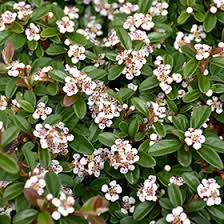
Cotoneaster dammeri, commonly called bearberry cotoneaster, is a dense, fast-growing, prostrate ground cover that grows to 1’ tall but spreads to 6’ wide or more on stiff, slender, prostrate branches that root at the nodes where they touch the ground. It is native to mountain regions, cliff sides, open mixed forests, and rocky ground in central to southern China. Alternate, leathery, elliptic to oblong, mostly evergreen leaves (to 1 1/ 4” long and to 5/8” wide) are glossy deep green above and gray-green below. Leaves acquire reddish-bronze to purple tones in winter. White, 5-petaled, 1/2” diameter flowers with purple anthers bloom singly or in pairs in May-June. Flowers are followed by red berries (pomes to 1-4” wide) which ripen in late summer but persist through winter unless consumed by birds or animals. Berry crop is often small.
| Requirement | |
|---|---|
| Hardiness | 5,6,7,8 |
| Heat Zones | 5,6,7,8 |
| Climate Zones | 5, 6, 7 |
| Plant Type | Shrubs |
| Plant Family | Rosacea |
| Exposure | Full Sun, Partial Sun |
| Season of Interest | Spring, Fall, Winter, Early Spring, Mid Spring, Late Spring |
| Height | < 1' |
| Spread | 4' - 5' |
| Water Needs | Average |
| Maintenance | Average |
| Soil Type | Loam, Acid |
| Characteristics | Showy, Attracts Butterflies, Drought Tolerant |
| Garden Styles | City and Courtyard, Coastal Garden, Formal Garden, Gravel and Rock Garden, Informal and Cottage, Modern Garden, Traditional Garden |
| Planting Place | Ground Covers |