
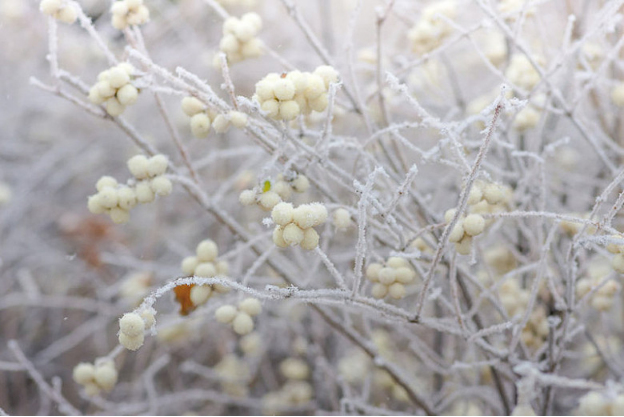
Common Snowberry, Snowberry, Waxberry, Symphoricarpos albus var. albus, Ice Apple, White Coralberry, White Snowberry, Symphoricarpos pauciflorus, Symphoricarpos racemosus
Noted for its very ornamental, pure white, waxy berries, Symphoricarpos albus (Snowberry) is a thicket-forming, deciduous shrub with upright to arching branches that is amazingly adaptable and undemanding. In early summer, a profusion of small, bell-shaped, white to pink flowers are borne in clusters in the leaf axils. Inconspicuous, they are of great interest to butterflies, hummingbirds and pollinators. The flowers are followed by abundant and attractive clusters of brilliant snow-white berries that persist well into winter. Birds, game birds and small mammals do enjoy them in winter months. The dense foliage of elliptic to rounded, blue-green leaves, remains attractive from spring to frost but provides little fall color.
| Requirement | |
|---|---|
| Hardiness | 3,4,5,6,7 |
| Heat Zones | 1,2,3,4,5,6,7 |
| Climate Zones | 4, 5, 6, 7, 8, 9, 10, 11, 15, 16, 17, 18, 19, 20, 21, 1B, 2A, 2B, 3A, A3, 1A, 3B |
| Plant Type | Shrubs |
| Plant Family | Aristolochiaceae |
| Exposure | Full Sun, Partial Sun, Shade |
| Season of Interest | Summer, Fall, Winter, Early Summer, Late Summer |
| Height | 3' - 4' |
| Spread | 3' - 4' |
| Water Needs | Average |
| Maintenance | Low |
| Soil Type | Chalk, Clay, Loam, Sand |
| Characteristics | Showy, Attracts Butterflies |
| Garden Styles | Informal and Cottage, Prairie and Meadow, Traditional Garden |
| Planting Place | Banks and Slopes, Beds and Borders, Hedges and Screens, Small Gardens, Wall-Side Borders, Walls and Fences |