
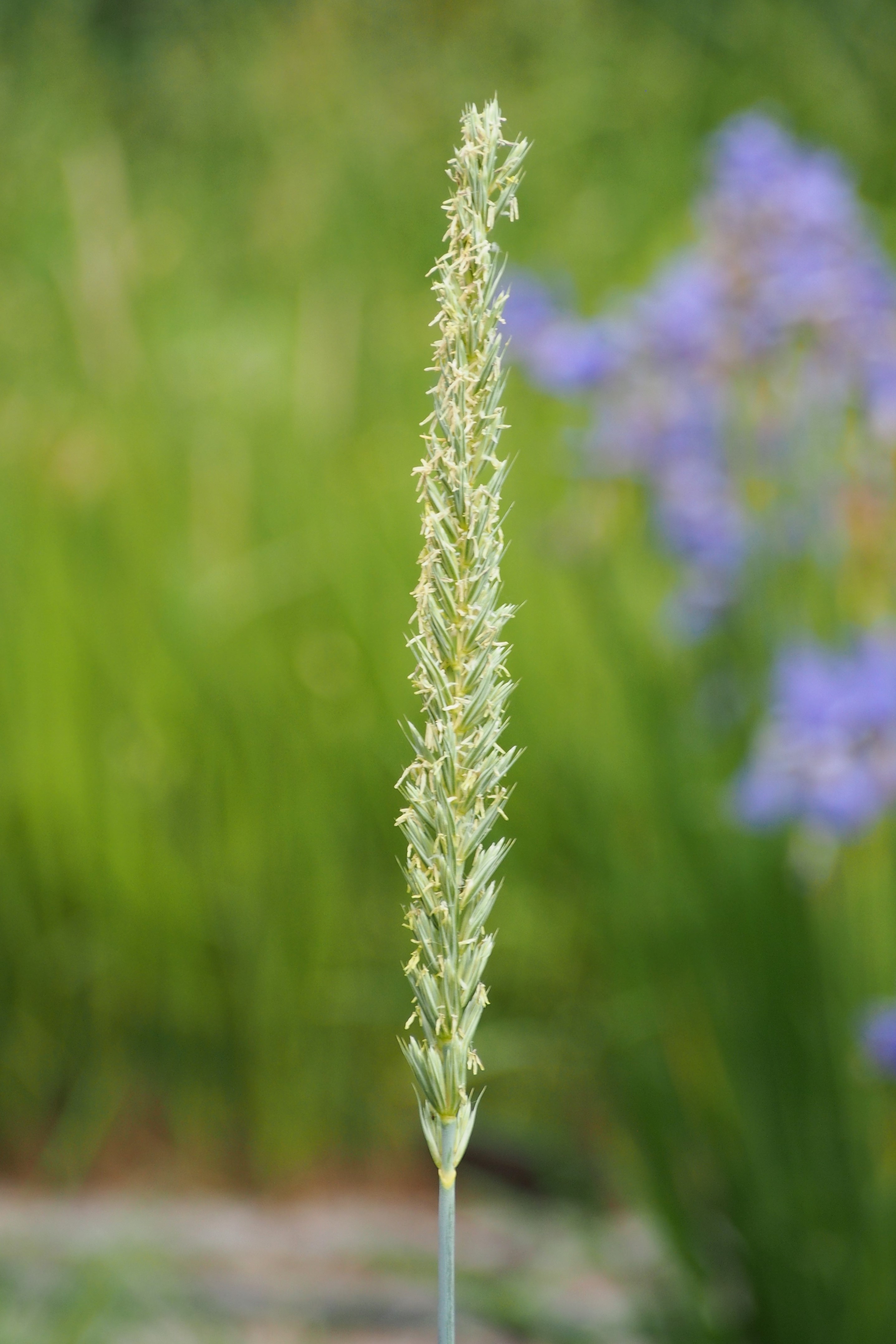
Elymus glaucus (Blue Wild Rye) is an erect, cool-season perennial bunchgrass forming a loose tuft of a few long, smooth, waxy stems and upright or arching, linear, bristly, blue-green leaves, up to 12 in. long (30 cm). Tall flower spikes, up to 5 ft. (150 cm), rise above the foliage in early and midsummer. The inflorescence is a dense, erect, narrow spike, 2-6 in. long (5-15 cm), made up of a few spikelets, that nods gently and gracefully sways in the breeze. Both foliage and spikes slowly turn straw-colored in the fall. Blue Wild Rye has a vigorous, fibrous root system, sometimes with rhizomes, and the stems may form stolons. It is a desirable species for use in erosion control. It is suitable for stream bank restoration, meadow, and swale seeding. It is also excellent for reseeding burned or disturbed areas in oak woodland or forest. It is very tolerant of fire, burning quickly with little downward heat transfer. Great for prairies and meadows, it is also a popular accent grass for the garden. Blue Wild Rye is the most common and widely distributed of the wild western ryes. It occurs throughout western North America, from Alaska to Ontario southward to New Mexico, northern Arizona, California, and Mexico. Blue Wild Rye also provides excellent wildlife habitats for mammals, birds, and waterfowl.
| Requirement | |
|---|---|
| Hardiness | 4,5,6,7,8,9 |
| Heat Zones | 4,5,6,7,8,9 |
| Climate Zones | 1, 2, 3, 4, 5, 6, 7, 8, 9, 10, 1B, 2A, 2B, 3A, 1A, 3B |
| Plant Type | Ornamental Grasses |
| Plant Family | Poaceae |
| Exposure | Full Sun, Partial Sun |
| Season of Interest | Spring, Summer, Fall, Mid Spring, Late Spring, Early Summer, Mid Summer, Late Summer |
| Height | 1' - 2', 4' - 5' |
| Spread | < 1' |
| Water Needs | Low, Average |
| Maintenance | Low |
| Soil Type | Acid, Alkaline, Neutral |
| Characteristics | Showy, Attracts Butterflies |
| Garden Styles | Informal and Cottage, Prairie and Meadow |
| Planting Place | Banks and Slopes, Beds and Borders, Ground Covers |