
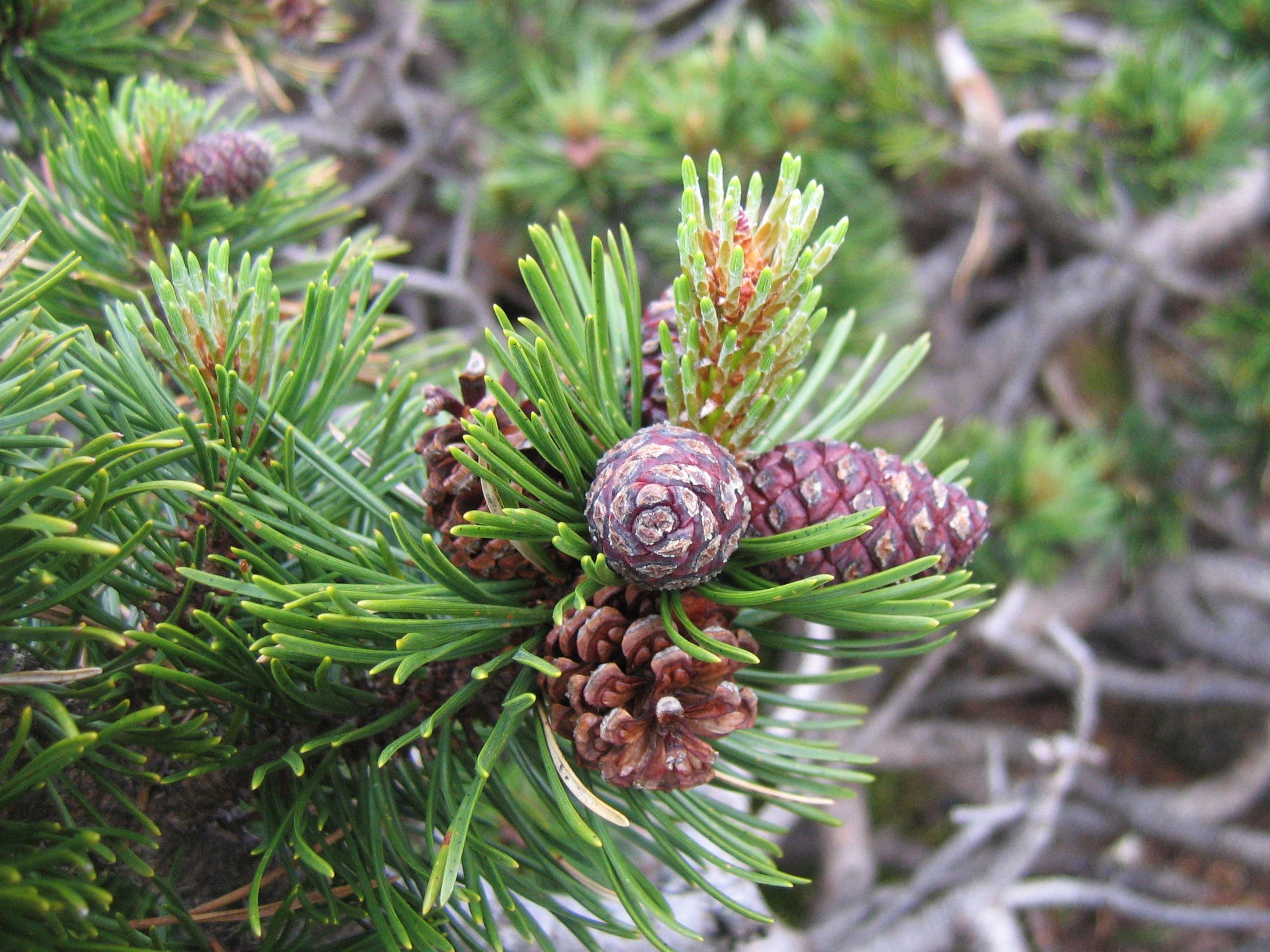
The Mugo pine is native to high-elevation habitats from southern to central Europe. The shrub is often used to control erosion and prevent avalanches.
The genus name, Pinus, is the Latin name for pines. The epithet, Mugo, is derived from Italian and means "small mountain pine."
This plant grows best in full sun and moist, well-drained loam or sandy soils. It is somewhat tolerant of partial shade and clay soils, but it is best to avoid wet or poorly-drained soils. Mugo pine prefers cool summer climates and is generally tolerant of urban conditions. It normally does not produce a tap root and is easy to transplant. Prune annually in late winter to keep its compact size. This shrub or tree is resistant to damage by deer.
The bark of the Mugo pine is grayish-brown with irregular plates. The needles are green, 1 to 3 inches long, rigid, and thick, and appear in bundles of two and have a slight twist. This shrub produces inconspicuous male and female pollen cones from May to July. The male pollen cone is greenish-yellow and 0.25 inches long. The female cone ripens in the fall and becomes oval to conical, sessile, 1 to 2.5 inches long, and dark brown.
| Requirement | |
|---|---|
| Hardiness | 3,4,5 |
| Heat Zones | 3,4,5,6,7 |
| Climate Zones | 3, 4, 5, 6 |
| Plant Type | Conifers |
| Plant Family | Pine family |
| Exposure | Full Sun, Partial Sun |
| Season of Interest | Winter |
| Height | 3' - 4' |
| Spread | 3' - 4' |
| Water Needs | Low, Average |
| Maintenance | Low |
| Soil Type | Acid |
| Characteristics | Evergreen |
| Garden Styles | City and Courtyard, Coastal Garden |
| Planting Place | Banks and Slopes |